 |
 |
A Brief History of Fermoy
Author Michael Barry
As Irish towns go, Fermoy is comparatively young but the territory of Fear Muighe can
be traced back into ancient Irish history,
when the O'Keeffes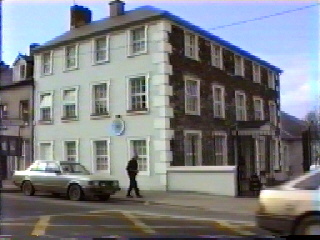 were its chieftains. Following the Norman invasion, the territory was
given to the Flemings from whom it later passed to the Roches. A monastery at Fermoy was
founded by St. Finnchua in the 7th Century and became a celebrated educational
establishment. In 117O, a Cistercian Abbey was founded and was known as The Abbey of Our Lady de Castro Dei. This Abbey was located to the rear of what is now the Resource Centre
in McCurtain St.
were its chieftains. Following the Norman invasion, the territory was
given to the Flemings from whom it later passed to the Roches. A monastery at Fermoy was
founded by St. Finnchua in the 7th Century and became a celebrated educational
establishment. In 117O, a Cistercian Abbey was founded and was known as The Abbey of Our Lady de Castro Dei. This Abbey was located to the rear of what is now the Resource Centre
in McCurtain St.
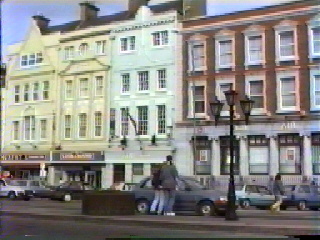 The town centre now stands on what was once the Abbey lands. Following the dissolution of
the monasteries, Queen Elizabeth gave the Abbey lands of Fermoy to Sir Richard Grenville,
a cousin of Sir Walter Raleigh, in 1591. In 1621, Sir Bernard Grenville, Sir Richard's
eldest son, sold the lands of Fermoy to Sir Lionel Cranfield (later the earl of Middlesex
and Lord Tresaurer of England). In 1624, Sir George Harvey purchased the lands of Fermoy
on behalf of Sir Richard Boyle, 1st Earl of Cork.
The town centre now stands on what was once the Abbey lands. Following the dissolution of
the monasteries, Queen Elizabeth gave the Abbey lands of Fermoy to Sir Richard Grenville,
a cousin of Sir Walter Raleigh, in 1591. In 1621, Sir Bernard Grenville, Sir Richard's
eldest son, sold the lands of Fermoy to Sir Lionel Cranfield (later the earl of Middlesex
and Lord Tresaurer of England). In 1624, Sir George Harvey purchased the lands of Fermoy
on behalf of Sir Richard Boyle, 1st Earl of Cork.
A timber bridge was built over the Blackwater in Fermoy in 1626 by the 1st Earl at a cost
of around five hundred pounds. The Cistercians operated a ferry prior to the building of
the bridge and the Earl had an income from this of twenty five pounds per annum. The
timber bridge was swept away in 1628 following "an extraordinary flood". There
was no immediate replacement and while provision was made in the Earl's Will in 1642 for
the erection of a new bridge, it wasn't until 1687 that the provision could be put into
effect. This was a bridge described by the historian Smith 6O years later as "A large
stone bridge of thirteen arches".
Charles Boyle, gave the lands to Nicholett Unett and Richard Graham as trustees in 1698. He died on 6th August 1704. In July 1705, these trustees together with Lancellot Burton and Anthony Spunett, his executors, sold the lands of Fermoy to Henry Luther who bought them on behalf of William Cockerille who died August 24th 1707. His widow, Barbara Cockerille, remarried Thomas Hodder and by her will, dated February 20th 1724, she gave the lands to her nephew, William Forward. He did not have a son and the land went to his six daughters, Barbara, Elizabeth, Mary, Rebecca, Margaret and Christina.
Up to the closing decades of the 18th century, Fermoy had little to show that it was in any way advancing in stature. In fact, the Rev. William Adair, who later played a prominent part in the life of the town, described the Fermoy of the 178Os as a village. "One of the meanest of the County, as with the exception of a single house of two storeys which served the purpose of a "carmans'' inn, it consisted of only two wretched mud wall huts, long since levelled .... Except for the beauty of its situation of which nature has been peculiarly lavish, the place did not offer a single circumstance to arrest the eye of the traveller who drove through it without observation and scarcely remembered he had not met with such a spot on the road".
All this was to change following the arrival of Scotsman John Anderson. He had come to Cork in 178O where he became a very successful business man and established the Mail Coach system between Cork and Dublin in 1789. He then turned his attention further afield, bought Fermoy Estate from the Forward family and proceeded to build a town.
THE BUILDING OF THE BARRACKS
 The French invasion attempt of Ireland in 1796 caused
great concern to the British Government and they sought land on which military bases could
be established. Fermoy was an ideal location on the river Blackwater and John Anderson
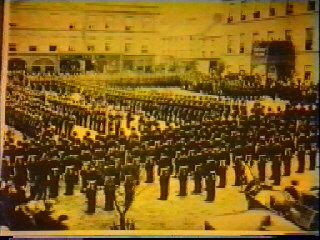
offered them land free. In 1797 the first troops began to arrive. In 18O6, barracks at the
east side of the Dublin road were built later to be called the "Old Barracks",
now the site of the Fermoy GAA complex. In 18O9 a further construction known as the
"New Barracks" on the west side took shape.
The French invasion attempt of Ireland in 1796 caused
great concern to the British Government and they sought land on which military bases could
be established. Fermoy was an ideal location on the river Blackwater and John Anderson
offered them land free. In 1797 the first troops began to arrive. In 18O6, barracks at the
east side of the Dublin road were built later to be called the "Old Barracks",
now the site of the Fermoy GAA complex. In 18O9 a further construction known as the
"New Barracks" on the west side took shape.
The garrison town of Fermoy grew rapidly from being " the meanest village in the county" to a town described by the Rev. J. Hall who stopped over in 18O7 as "a place rising fast into importance and containing about two thousand inhabitants, besides barracks for as many soldiers. A few years ago, Fermoy consisted of only a few miserable huts."
The military strength based in Fermoy varied over the years, fluctuating with the political scene as it affected the British Empire. The largest number of troops ever to be stationed in Fermoy would have probably been before the Battle of Waterloo in 1815. The Duke of Wellington visited the barracks at that time and it was from Fermoy Barracks that a very large contingent of the troops left to do battle against Napoleon. Waterloo Lane which runs down to the river at the corner of the old Vocational School, now Scoil de Hide, commemorates their departure.
John Anderson built his own Paladian style house on the Mallow side of the Blackwater. It
was known locally as 'Fermoy House' and was situated on the site where John McCarthy of
John McCarthy Motors now has his fine modern residence. A hotel was built on the Square to
replace the old "carman's" inn and associated with it was built a Coach Station,
Post Office, Livery Stables and the Mail Coach Factory. The Protestant Church (Christ
Church) was consecrated in 18O9 and the Rev. William Adair already mentioned became its
first rector.
The Roman Catholic parish priest of Fermoy when John Anderson began building the town was
the Rev. Dr. Edmond Barry of Ballinahina. 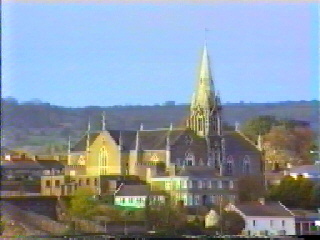 He
had served as curate for six years before replacing Rev. Fr. Noonan as Parish Priest in
1781 a position he held for sixty years. John Anderson provided land on which to build a
new Catholic Church at "a nominal rent, with the reservation of one pew in it for
such Catholic guests as he might have from time to time and for the family of Captain
O'Flanagan, the Barracks Master."
He
had served as curate for six years before replacing Rev. Fr. Noonan as Parish Priest in
1781 a position he held for sixty years. John Anderson provided land on which to build a
new Catholic Church at "a nominal rent, with the reservation of one pew in it for
such Catholic guests as he might have from time to time and for the family of Captain
O'Flanagan, the Barracks Master."
In his book Beauties of Ireland, J. H. Brewer stated that John Anderson also gave five hundred pounds towards the erection of the chapel on condition that the further sum of fifteen hundred pounds should be contributed by the persons for whose accommodation the building was designed. The building of the church went ahead, referred to in Pigot's Directory of 1824 as "a spacious Catholic Chapel built in 1811".
Fermoy Bridge, already referred to, was also experiencing problems with the expansion of the town and the increase in road traffic. In the years 1864/1865 a new bridge replaced the old structure. While the work was in progress a temporary wooden bridge was erected from Bank Street (now Kent Street) across to the Esplanade on the northern river bank by the Rathealy Road.
EDUCATION IN FERMOY
Education was very much to the forefront in the developing town of Fermoy. By the end of the 183Os there had been at one time or other about sixteen schools in and around the town. The Adair School and Fermoy College (later known as the Manor House) were two noted establishments for Protestant children. Fr. Fitzpatrick had a school in two rooms of a private house, probably Ivy House (later home of the Fitzgeralds north of the bridge.) There, pupils got a classical education and the first report of the Royal Commission of Irish Education in 1826 tells us that the school had 55 Catholic and 3 Protestant boys paying fees ranging from thirty shillings to four pounds per annum. John Byrne also had a Catholic school at that time with 12O boys attending. It was a day school "in a private house built of stone and mortar and worth £15O." There was also a Catholic Free School for girls conducted by a lady named Mary Murphy.
In the Cork Road area of Fermoy, Michael Roche had a school of 63 Catholic and 7 Protestant pupils. The first Catholic National School was opened in 1833, the man responsible being the Rev. Fr. T. Murphy who served both as curate and parish priest of Fermoy. He later became Bishop of Cloyne. The school, built then at a cost of £6OO, had 2OO boys and 133 girls on the rolls in 1835.
The period 1832-1834 was one of great distress in the Fermoy area as it was indeed throughout Ireland when a cholera epidemic swept the land. A Cholera Board was established in 1832 and Fermoy had its local Board of Health to deal with the crisis which had a profound affect especially on the poor. On the 6th May 1832, the local Board sought the sum of £2OO to alleviate the distress and it is interesting to see their reply to one of the questions on their application form. The question was "What are the chief-means of employment for the Poor in your parish or District." The reply was as follows: "The Town of Fermoy contains a large flour mill, a brewery and a paper mill which, with an extensive corn and butter store, afford considerable means of employment to the poor but there remains besides, a large pauper population, some drawing a scanty subsistence from occasional agricultural employment afforded by the neighbouring farmers and many without any ostensible means of existence save what charity may afford."
THE ARRIVAL OF THE NUNS AND BROTHERS
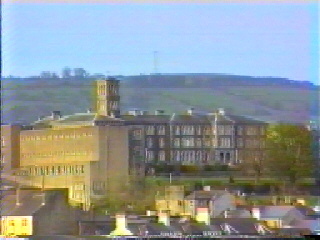 In 1838 the Presentation Nuns came and opened a
school in Fermoy. The first Loreto nuns came to town in 1853 and soon established their
Convent School. In 1858 St. Colman's College was opened, which later became a noted GAA
stronghold. In 1863 the Christian Brothers came to Fermoy and had their first school where
the CYMS Hall and Parish Centre now are. The Great Famine of the 184Os left its scars, the
famine graveyards bearing testimony to the large number who died inside and outside the
Workhouse. A new Workhouse known as "The Union" was built just outside the town
on the Tallow road in 1858. This became St. Patrick's Hospital in the 192Os.
In 1838 the Presentation Nuns came and opened a
school in Fermoy. The first Loreto nuns came to town in 1853 and soon established their
Convent School. In 1858 St. Colman's College was opened, which later became a noted GAA
stronghold. In 1863 the Christian Brothers came to Fermoy and had their first school where
the CYMS Hall and Parish Centre now are. The Great Famine of the 184Os left its scars, the
famine graveyards bearing testimony to the large number who died inside and outside the
Workhouse. A new Workhouse known as "The Union" was built just outside the town
on the Tallow road in 1858. This became St. Patrick's Hospital in the 192Os.
RAILWAY STATION
The year 186O saw the opening of Fermoy Railway. Its operation proved to be of great benefit to the town and its people. A summary of the 1871 census returns for the town of Fermoy gives the following data. There were 7337 inhabitants listed. Roman Catholics made up 5485 of that number, the remainder being Protestant, Presbyterian, Methodist etc. Market day was on Saturdays. The mail arrived at 5 am from Mallow by Mail Car (horse drawn) and at 2 p.m. by train. The mail left Fermoy by train to Mallow at noon and also at 7.2O p.m. by Mail Car. The town's postmaster was David Rice and the station master was John Coleman. Trains to Cork from Fermoy via Mallow ran at 8 am, 12.14 p.m. and 5.3O p.m. Single fares were five shillings and three pence, four shillings and two pence and the lowest fare being two shillings. The return fares were eight shillings and nine pence, seven shillings and a low fare of three shillings and six pence. The railway in Fermoy closed in 1967 Following the War of Independence the British left Fermoy and the barracks were destroyed during the Irish Civil War 1922/1923.
Today, Fermoy is a thriving town.